

-
1 abartig
I Adj. abnormal; Verhalten: auch perverse* * *ạb|ar|tig1. adj2) (= widersinnig) perverseich halte das Ganze für ziemlich abartig — I think the whole thing is really crazy (inf)
2. advinf = widerlich) abnormallydas tut abartig weh — that hurts like hell (inf)
abartig lang — a hell of a long time (inf)
* * *ab·ar·tigI. adjeine \abartige Neigung haben to have abnormal [or deviant] tendenciesII. adv1. (abnorm) abnormally2. (sl) reallymein Kopf tut \abartig weh I've got a splitting headachedas hat \abartig lang gedauert that took absolute ages3. (pervers) pervertedly* * *Adjektiv deviant; abnormal* * *A. adj abnormal; Verhalten: auch perverse* * *Adjektiv deviant; abnormal* * *adj.abnormal adj.weird adj. -
2 vorzeitig
I Adj. premature; (früh) early; vorzeitige Ausfälle EDV abnormal interruptions; vorzeitige Beendigung EDV abnormal termination* * *forward (Adj.); untimely (Adj.); abortive (Adj.); premature (Adj.)* * *vor|zei|tig1. adjearly; Geburt, Altern etc premature2. advearly, prematurely* * *vor·zei·tig[ˈfo:ɐ̯tsaitɪç]wir alle haben den \vorzeitigen Weggang dieser geschätzten Mitarbeiter bedauert we were all sorry to see these well-respected colleagues retire early* * *1.Adjektiv premature; early < retirement>2.adverbial prematurely; < be retired> early* * *vorzeitige Ausfälle IT abnormal interruptions;vorzeitige Beendigung IT abnormal terminationvorzeitig sterben die before one’s time* * *1.Adjektiv premature; early < retirement>2.adverbial prematurely; < be retired> early* * *adj.abortive adj.premature adj.untimely adj. adv.abortively adv.prematurely adv. -
3 Leistungsschalter
автоматический выключатель
Механический коммутационный аппарат1), способный включать, проводить и отключать токи при нормальном состоянии электрической цепи, а также включать, проводить в течение заданного времени и автоматически отключать токи в указанном аномальном состоянии электрической цепи, например, при коротком замыкании.
(МЭС 441-14-20)
[ ГОСТ Р 50030. 2-99 ( МЭК 60947-2-98)]
автоматический выключатель
-
[IEV number 442-05-01]EN
circuit breaker
a mechanical switching device, capable of making, carrying and breaking currents under normal circuit conditions and also making, carrying for a specified time and breaking currents under specified abnormal circuit conditions such as those of short circuit.
[IEC 62271-100, ed. 2.0 (2008-04)]
[IEV number 442-05-01]
circuit breaker
A device designed to open and close a circuit by nonautomatic means and to open the circuit automatically on a predetermined overcurrent without damage to itself when properly applied within its rating.
NOTE The automatic opening means can be integral, direct acting with the circuit breaker, or remote from the circuit breaker.
Adjustable (as applied to circuit breakers). A qualifying term indicating that the circuit breaker can be set to trip at various values of current, time, or both within a predetermined range. Instantaneous-trip (as applied to circuit breakers). A qualifying term indicating that no delay is purposely introduced in the tripping action of the circuit breaker.
Inverse-time (as applied to circuit breakers). A qualifying term indicating a delay is purposely introduced in the tripping action of the circuit breaker, which delay decreases as the magnitude of the current increases.
Nonadjustable (as applied to circuit breakers). A qualifying term indicating that the circuit breaker does not have any adjustment to alter the value of current at which it will trip or the time required for its operation.
Setting (of a circuit breaker). The value of current, time, or both at which an adjustable circuit breaker is set to trip.
[National Electrical Cod]FR
disjoncteur
1) Должно быть контактный коммутационный аппарат
appareil mécanique de connexion capable d’établir, de supporter et d’interrompre des courants dans les conditions normales du circuit, ainsi que d’établir, de supporter pendant une durée spécifiée et d’in- terrompre des courants dans des conditions anormales spécifiées du circuit telles que celles du court-circuit.
[IEC 62271-100, ed. 2.0 (2008-04)]
[IEV number 442-05-01]
[Интент]КЛАССИФИКАЦИЯ
- По роду тока
- По напряжению
- По числу полюсов
- По виду корпуса
- По месту установки
- По изолирующей среде
- По установленным расцепителям
- По дополнительным защитам
- По назначению
- По категории применения
- По виду привода взвода пружины
- По выполняемой функции
-
По влиянию монтажного положения
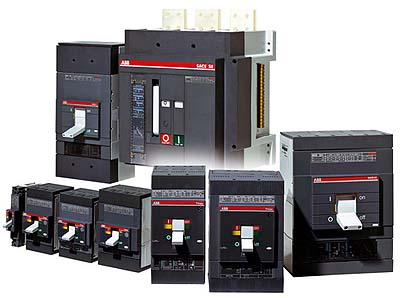 Автоматические выключатели ABB
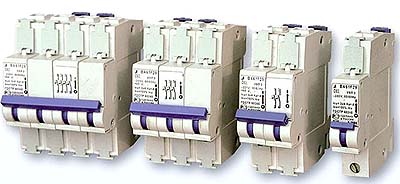 Модульные автоматические выключатели
1. НЕКОТОРЫЕ СВЕДЕНИЯ ОБ АВТОМАТИЧЕСКИХ ВЫКЛЮЧАТЕЛЯХ Автоматический выключатель — это электрический аппарат, который автоматически отключает (и тем самым защищает) электрическую цепь при возникновении в ней аномального режима. Режим становится аномальным, когда в цепи начинает недопустимо изменяться (т. е. увеличиваться или уменьшаться относительно номинального значения) ток или напряжение.
Другими словами (более "инженерно") можно сказать, что автоматический выключатель защищает от токов короткого замыкания и токов перегрузки отходящую от него питающую линию, например, кабель и приемник(и) электрической энергии (осветительную сеть, розетки, электродвигатель и т. п.).
Как правило, автоматический выключатель может применятся также для нечастого (несколько раз в сутки) включения и отключения защищаемых электроприемников (защищаемой нагрузки).
[Интент]Выключатель предназначен для проведения тока в нормальном режиме и отключения тока при коротких замыканиях, перегрузках, недопустимых снижениях напряжения, а также до 30 оперативных включений и отключений электрических цепей в сутки и рассчитан для эксплуатации в электроустановках с номинальным рабочим напряжением до 660 В переменного тока частоты 50 и 60 Гц и до 440 В постоянного тока.
[Типовая фраза из российской технической документации] 2. ПРИНЦИП ДЕЙСТВИЯ Для защиты цепи от короткого замыкания применяется автоматический выключатель с электромагнитным расцепителем.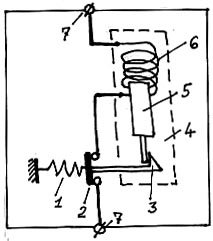
1 - Пружина (в данном случае во взведенном положении растянута)
Автоматический выключатель устроен таким образом, что сначала необходимо взвести пружину и только после этого его можно включить. У многих автоматических выключателей для взвода пружины необходимо перевести ручку вниз. После этого ручку переводят вверх. При этом замыкаются главные контакты.
2 - Главный контакт автоматического выключателя
3 - Удерживающее устройство
4 - Электромагнитный расцепитель;
5 - Сердечник
6 - Катушка
7 - Контактные зажимы автоматического выключателя
На рисунке показан один полюс автоматического выключателя во включенном положении: пружина 1 взведена, а главный контакт 2 замкнут.
Как только в защищаемой цепи возникнет короткое замыкание, ток, протекающий через соответствующий полюс автоматического выключателя, многократно возрастет. В катушке 6 сразу же возникнет сильное магнитное поле. Сердечник 5 втянется в катушку и освободит удерживающее устройство. Под действием пружины 1 главный контакт 2 разомкнется, в результате чего автоматический выключатель отключит и тем самым защитит цепь, в которой возникло короткое замыкание. Такое срабатывание автоматического выключателя происходит практически мгновенно (за сотые доли секунды).
Для защиты цепи от тока перегрузки применяют автоматические выключатели с тепловым расцепителем.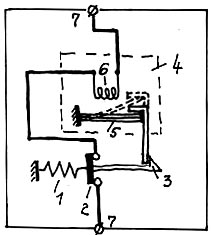
1 - Пружина (в данном случае во взведенном положении растянута)
Принцип действия такой же как и в первом случае, с той лишь разницей, что удерживающее устройство 3 освобождается под действием биметаллической пластины 5, которая изгибается от тепла, выделяемого нагревательным элементом 6. Количество тепла определяется током, протекающим через защищаемую цепь.
2 - Главный контакт автоматического выключателя
3 - Удерживающее устройство
4 - Тепловой расцепитель
5 - Биметаллическая пластина
6 - Нагревательный элемент
7 - Контактные зажимы автоматического выключателя
[Интент]Недопустимые, нерекомендуемые
Тематики
Классификация
>>>Обобщающие термины
Действия
- включение автоматического выключателя
- оперирование автоматического выключателя
- отключение автоматического выключателя
- срабатывание автоматического выключателя
EN
- auto-cutout
- automatic circuit breaker
- automatic cutout
- automatic switch
- breaker
- CB
- circuit breaker
- circuit-breaker
- cutout
DE
FR
Смотри также
силовой выключатель
-
[Интент]EN
circuit-breaker
a mechanical switching device, capable of making, carrying and breaking currents under normal circuit conditions and also making, carrying for a specified time and breaking currents under specified abnormal circuit conditions such as those of short circuit
[IEV ref 441-14-20]FR
disjoncteur
appareil mécanique de connexion capable d'établir, de supporter et d'interrompre des courants dans les conditions normales du circuit, ainsi que d'établir, de supporter pendant une durée spécifiée et d'interrompre des courants dans des conditions anormales spécifiées du circuit telles que celles du court-circuit
[IEV ref 441-14-20]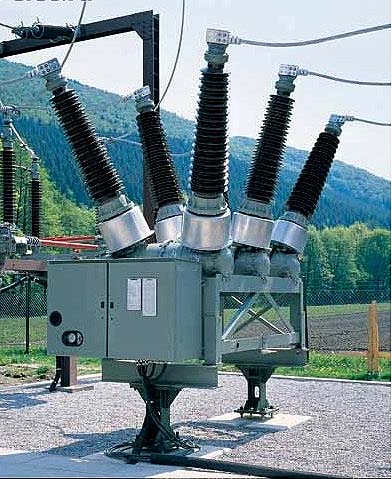
Рис. Siemens
Силовой ( баковый элегазовый) выключатель 3AP1 DT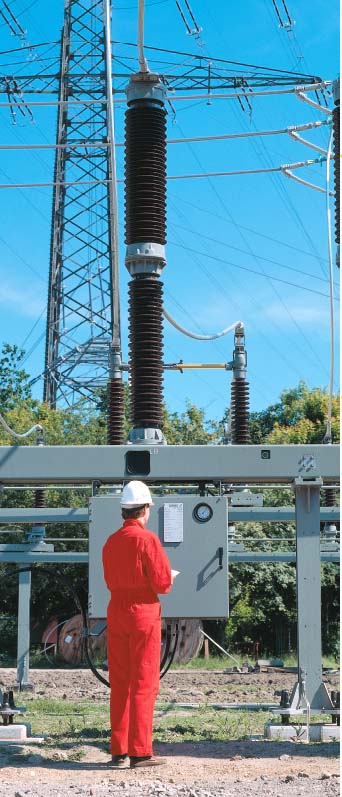
Рис. Siemens
Силовой (колонковый элегазовый) выключательТематики
- высоковольтный аппарат, оборудование...
- комплектное распред. устройство (КРУ)
EN
DE
FR
Немецко-русский словарь нормативно-технической терминологии > Leistungsschalter
4 Selbstschalter
автоматический выключатель
Механический коммутационный аппарат1), способный включать, проводить и отключать токи при нормальном состоянии электрической цепи, а также включать, проводить в течение заданного времени и автоматически отключать токи в указанном аномальном состоянии электрической цепи, например, при коротком замыкании.
(МЭС 441-14-20)
[ ГОСТ Р 50030. 2-99 ( МЭК 60947-2-98)]
автоматический выключатель
-
[IEV number 442-05-01]EN
circuit breaker
a mechanical switching device, capable of making, carrying and breaking currents under normal circuit conditions and also making, carrying for a specified time and breaking currents under specified abnormal circuit conditions such as those of short circuit.
[IEC 62271-100, ed. 2.0 (2008-04)]
[IEV number 442-05-01]
circuit breaker
A device designed to open and close a circuit by nonautomatic means and to open the circuit automatically on a predetermined overcurrent without damage to itself when properly applied within its rating.
NOTE The automatic opening means can be integral, direct acting with the circuit breaker, or remote from the circuit breaker.
Adjustable (as applied to circuit breakers). A qualifying term indicating that the circuit breaker can be set to trip at various values of current, time, or both within a predetermined range. Instantaneous-trip (as applied to circuit breakers). A qualifying term indicating that no delay is purposely introduced in the tripping action of the circuit breaker.
Inverse-time (as applied to circuit breakers). A qualifying term indicating a delay is purposely introduced in the tripping action of the circuit breaker, which delay decreases as the magnitude of the current increases.
Nonadjustable (as applied to circuit breakers). A qualifying term indicating that the circuit breaker does not have any adjustment to alter the value of current at which it will trip or the time required for its operation.
Setting (of a circuit breaker). The value of current, time, or both at which an adjustable circuit breaker is set to trip.
[National Electrical Cod]FR
disjoncteur
1) Должно быть контактный коммутационный аппарат
appareil mécanique de connexion capable d’établir, de supporter et d’interrompre des courants dans les conditions normales du circuit, ainsi que d’établir, de supporter pendant une durée spécifiée et d’in- terrompre des courants dans des conditions anormales spécifiées du circuit telles que celles du court-circuit.
[IEC 62271-100, ed. 2.0 (2008-04)]
[IEV number 442-05-01]
[Интент]КЛАССИФИКАЦИЯ
- По роду тока
- По напряжению
- По числу полюсов
- По виду корпуса
- По месту установки
- По изолирующей среде
- По установленным расцепителям
- По дополнительным защитам
- По назначению
- По категории применения
- По виду привода взвода пружины
- По выполняемой функции
-
По влиянию монтажного положения
Автоматические выключатели ABB
Модульные автоматические выключатели
1. НЕКОТОРЫЕ СВЕДЕНИЯ ОБ АВТОМАТИЧЕСКИХ ВЫКЛЮЧАТЕЛЯХ Автоматический выключатель — это электрический аппарат, который автоматически отключает (и тем самым защищает) электрическую цепь при возникновении в ней аномального режима. Режим становится аномальным, когда в цепи начинает недопустимо изменяться (т. е. увеличиваться или уменьшаться относительно номинального значения) ток или напряжение.
Другими словами (более "инженерно") можно сказать, что автоматический выключатель защищает от токов короткого замыкания и токов перегрузки отходящую от него питающую линию, например, кабель и приемник(и) электрической энергии (осветительную сеть, розетки, электродвигатель и т. п.).
Как правило, автоматический выключатель может применятся также для нечастого (несколько раз в сутки) включения и отключения защищаемых электроприемников (защищаемой нагрузки).
[Интент]Выключатель предназначен для проведения тока в нормальном режиме и отключения тока при коротких замыканиях, перегрузках, недопустимых снижениях напряжения, а также до 30 оперативных включений и отключений электрических цепей в сутки и рассчитан для эксплуатации в электроустановках с номинальным рабочим напряжением до 660 В переменного тока частоты 50 и 60 Гц и до 440 В постоянного тока.
[Типовая фраза из российской технической документации] 2. ПРИНЦИП ДЕЙСТВИЯ Для защиты цепи от короткого замыкания применяется автоматический выключатель с электромагнитным расцепителем.1 - Пружина (в данном случае во взведенном положении растянута)
Автоматический выключатель устроен таким образом, что сначала необходимо взвести пружину и только после этого его можно включить. У многих автоматических выключателей для взвода пружины необходимо перевести ручку вниз. После этого ручку переводят вверх. При этом замыкаются главные контакты.
2 - Главный контакт автоматического выключателя
3 - Удерживающее устройство
4 - Электромагнитный расцепитель;
5 - Сердечник
6 - Катушка
7 - Контактные зажимы автоматического выключателя
На рисунке показан один полюс автоматического выключателя во включенном положении: пружина 1 взведена, а главный контакт 2 замкнут.
Как только в защищаемой цепи возникнет короткое замыкание, ток, протекающий через соответствующий полюс автоматического выключателя, многократно возрастет. В катушке 6 сразу же возникнет сильное магнитное поле. Сердечник 5 втянется в катушку и освободит удерживающее устройство. Под действием пружины 1 главный контакт 2 разомкнется, в результате чего автоматический выключатель отключит и тем самым защитит цепь, в которой возникло короткое замыкание. Такое срабатывание автоматического выключателя происходит практически мгновенно (за сотые доли секунды).
Для защиты цепи от тока перегрузки применяют автоматические выключатели с тепловым расцепителем.1 - Пружина (в данном случае во взведенном положении растянута)
Принцип действия такой же как и в первом случае, с той лишь разницей, что удерживающее устройство 3 освобождается под действием биметаллической пластины 5, которая изгибается от тепла, выделяемого нагревательным элементом 6. Количество тепла определяется током, протекающим через защищаемую цепь.
2 - Главный контакт автоматического выключателя
3 - Удерживающее устройство
4 - Тепловой расцепитель
5 - Биметаллическая пластина
6 - Нагревательный элемент
7 - Контактные зажимы автоматического выключателя
[Интент]Недопустимые, нерекомендуемые
Тематики
Классификация
>>>Обобщающие термины
Действия
- включение автоматического выключателя
- оперирование автоматического выключателя
- отключение автоматического выключателя
- срабатывание автоматического выключателя
EN
- auto-cutout
- automatic circuit breaker
- automatic cutout
- automatic switch
- breaker
- CB
- circuit breaker
- circuit-breaker
- cutout
DE
FR
Смотри также
Немецко-русский словарь нормативно-технической терминологии > Selbstschalter
5 Risiko
Risiko n 1. FIN exposure; 2. GEN risk, venture, hazard, contingency; 3. STAT, VERSICH risk; 4. WIWI venture, peril • auf Risiko BÖRSE at risk • auf Risiko des Empfängers GEN at receiver’s risk • auf Risiko des Käufers BÖRSE at buyer’s risk • das Risiko abdecken BÖRSE cover the risk, meet the risk • das Risiko eingehen GEN run the risk of • das Risiko tragen BÖRSE bear the risk • ein Risiko eingehen GEN take a risk • gegen alle Risiken IMP/EXP, VERSICH against all risks, AAR • im Risiko stehen FIN be exposed to • jedes Risiko VERSICH all peril, all risks, A/R • kein Risiko bis zur Bestätigung VERSICH no risk until confirmed, nr • kein Risiko eingehen GEN play safe • kein Risiko nach Löschung VERSICH no risk after discharge, nrad • Risiken mischen VERSICH spread risks • Risiken streuen VERSICH spread risks • Risiken verteilen VERSICH spread risks • Risiko, arbeitslos zu werden PERS, SOZ risk of becoming unemployed • Risiko geht mit Eigentum über RECHT risk passes with property (Vertragsprinzip) • Risiko nach oben BÖRSE upside risk* * *n 1. < Finanz> exposure; 2. < Geschäft> risk, venture, hazard, contingency; 3. <Math, Versich> risk; 4. <Vw> venture, peril ■ auf Risiko < Börse> at risk ■ auf Risiko des Empfängers < Geschäft> at receiver's risk ■ auf Risiko des Käufers < Börse> at buyer's risk ■ das Risiko abdecken < Börse> cover the risk, meet the risk ■ das Risiko eingehen < Geschäft> run the risk of ■ das Risiko tragen < Börse> bear the risk ■ ein Risiko eingehen < Geschäft> take a risk ■ gegen alle Risiken <Imp/Exp, Versich> against all risks (AAR) ■ im Risiko stehen < Finanz> be exposed to ■ jedes Risiko < Versich> all peril, all risks (A/R) ■ kein Risiko bis zur Bestätigung < Versich> no risk until confirmed (nr) ■ kein Risiko eingehen < Geschäft> play safe ■ kein Risiko nach Löschung < Versich> no risk after discharge (nrad) ■ Risiken mischen < Versich> spread risks ■ Risiken streuen < Versich> spread risks ■ Risiken verteilen < Versich> spread risks ■ Risiko geht mit Eigentum über < Recht> Vertragsprinzip risk passes with property ■ Risiko nach oben < Börse> upside risk* * *Risiko
risk, hazard, jeopardy, venture, peril;
• auf eigenes Risiko at one’s own risk;
• auf Risiko des Käufers caveat emptor, let the buyer beware;
• kein Risiko eingehend safe, cautious;
• wohl abgewogenes Risiko calculated risk;
• von der Lebensdauer abhängiges Risiko life contingency;
• abzuschätzendes Risiko expectable risk;
• akzeptables Risiko good risk;
• anomales Risiko substandard risk;
• ausgeschlossenes Risiko excluded risk;
• außerordentliches Risiko extraordinary risk;
• bankfremdes Risiko non-banking venture;
• begrenztes Risiko time risk;
• bekanntes Risiko (Versicherung) known risk;
• berufliches Risiko risk of occupation, risk incident to employment;
• auf einen Einzelfall beschränktes Risiko particular risk;
• unmittelbar bevorstehendes Risiko imminent risk;
• erhebliches Risiko substantial risk;
• erhöhtes Risiko abnormal (substandard, aggravated) risk, (Lebensversicherung) impaired life;
• durch andere Arbeitnehmer erhöhtes Risiko extraordinary hazard;
• klar erkennbares Risiko obvious risk;
• feststellbares Risiko perceivable risk;
• finanzielles Risiko financial risk;
• gedecktes Risiko risk covered;
• nicht gedecktes Risiko uncovered risk;
• geschäftliches Risiko commercial risk;
• besonders hohes Risiko substandard risk;
• juristisches Risiko legal hazard;
• falsch kalkuliertes Risiko risk failure;
• normales Risiko standard risk;
• offensichtliches Risiko obvious risk;
• operationelles Risiko operational risk;
• noch nicht platziertes Risiko (Versicherung) balance of risk;
• subjektives Risiko (Versicherung) moral hazard;
• tätigkeitsbedingtes Risiko special risk;
• tatsächliches Risiko physical hazard;
• übersehbares (überschaubares) Risiko perceivable risk;
• unbekanntes Risiko unknown risk;
• ungedecktes Risiko uninsured (uncovered) risk;
• unkalkulierbares Risiko unexpectable risk;
• unterdurchschnittliches Risiko (Lebensversicherung) substandard risk;
• unternehmerisches Risiko risk of an undertaking;
• versicherbares Risiko insurable risk, hazard;
• nicht versicherbares (versicherungsfähiges) Risiko uninsurable risk;
• versichertes Risiko contingency risk;
• wirtschaftliches Risiko commercial risk;
• wohlerwogenes Risiko perceivable risk;
• zugehöriges Risiko related risk;
• zweiseitiges Risiko bilateral risk;
• Risiko falscher Angaben des Versicherten moral hazard;
• Risiko abgeschwächter Börsenkurse market’s downslide risk;
• Risiko im Debitorenbereich default risk;
• Risiko höherer Gewalt fundamental risk;
• Risiko beim Landtransport land risk;
• Risiko im engeren Sinn pure risk;
• Risiko der technischen Überalterung risk of technical obsolescence;
• Risiko abdecken to cover a risk;
• Risiko abwägen to calculate the risk;
• sein Geld mit verteiltem Risiko anlegen to diversify one’s investments;
• Risiko ausschalten (ausscheiden) to eliminate a risk;
• sich einem Risiko aussetzen to incur a risk;
• unnötigem Risiko aussetzen to expose to unnecessary risks;
• sich dem Risiko der Verhängung einer Geldstrafe aussetzen to make o. s. liable to a fine;
• von einem Risiko befreien to relieve of a risk;
• überdurchschnittliches Risiko darstellen to be an above-average risk;
• Risiko eingehen to take (incur, undertake, run) a risk;
• großes Risiko eingehen to take close chances;
• kalkuliertes Risiko eingehen to take a calculable gamble;
• kein Risiko eingehen to take no risks, to play for safety;
• zum besonders hohen Risiko erklären to class as high risk;
• Risiko laufen to run a risk;
• hohes Risiko auf sich nehmen to chance a high risk;
• erheblichem Risiko ausgesetzt sein to be exposed to considerable risk;
• Risiko tragen to bear the risk;
• Risiko übernehmen to accept (assume, incur, entertain, undertake) a risk;
• volles Risiko übernehmen to assume all risks;
• Risiko der Selbstbelastung vermeiden to avoid the risk of incriminating o. s.;
• Risiko verteilen to spread a risk;
• Risikoabgrenzung risk limitation;
• Risikoabschätzung calculation of risk, risk appraisal;
• Risikoabsicherung coverage of a risk;
• Risikoabteilung (Versicherung) underwriting department;
• Risikoabwägung weighing of risk;
• Risikoabwälzung shifting (passing) of risk;
• Risikoanalyse risk (venture) analysis;
• Risikoanlagenberater venture manager;
• hochverzinsliche Risikoanleihen junk bonds;
• Risikoarten types of hazard (risks);
• Risikoausgleich spreading the risk;
• Risikoauslese selection of risks;
• Risikoausschluss exception;
• Risikoausschluss bei Gebäudeeinsturz falling-building clause;
• Risikoausschlussklausel excepted peril clause;
• Risikoauswirkung effects of risk;
• Risikobearbeiter risk manager;
• Risikobeginn (Versicherung) attachment of risk;
• Risikobegrenzung bei Häufigkeit von Bränden conflagration line limits;
• Risikobegrenzung bei Katastrophen catastrophe limit;
• Risikobereitschaft readiness (willingness) to take risks;
• Risikobeschreibung (Versicherung) representation;
• Versicherung unter Risikobeteiligung übernehmen to underwrite a risk;
• Risikobetrag (Lebensversicherung) net amount at risk;
• Risiko beurteilung, Risikoeinschätzung assessment of risk, risk assessment;
• Risikobewertung risk evaluation (assessment);
• Risikodeckung insurance against (covering) a risk;
• Risikoeinstufung classification of risks;
• Risikoelemente essentials (elements) of risk;
• Risikoerhöhung aggravation of risk, increase of hazard, [peril] added risk;
• Risikoerklärung (Schiffskapitän) bill of adventure;
• Risikofaktor risk factor;
• Risikoformular running (reporting) form;
• Risikofunktion risk function;
• Risikogattungen types of risk (hazard);
• Risikogeschäft speculative enterprise, adventure, (Lebensversicherung) substandard business;
• Risikohäufung accumulation of risks;
• Risikoherabsetzung reduction in hazard;
• Risikoinvestition risky investment;
• Risikokapital risk[-bearing] (venture) capital;
• neues Risikokapital auftreiben to raise fresh venture capital;
• Risikokapitalgeber venture capitalist;
• Risikoklasse category (class) of risk, (Transportversicherung) rate;
• Risikoklassifizierung hazard classification;
• Risikolebensversicherung term life insurance;
• verlängerungsfähige Risikolebensversicherung renewable term [life] insurance (assurance, Br.).6 Störung
Störung2 f TECH abnormal condition, breakdown, down-time, failure, fault, irregularity, malfunction, power failure, trouble (z. B. eines Gerätes); upset; dislocation (des Atomgitters)7 Lastschalter
выключатель (контактный)
Контактный коммутационный аппарат, способный включать, проводить и отключать токи в нормальных условиях, в том числе при оговоренных рабочих перегрузках, а также в течение установленного времени проводить ток в оговоренных аномальных условиях, например при коротком замыкании.
МЭК 60050(441-14-10)
Примечание. Выключатель может быть способен включать, но не отключать ток короткого замыкания.
[ ГОСТ Р 50030. 1-2000 ( МЭК 60947-1-99)]EN
(mechanical) switch
a mechanical switching device capable of making, carrying and breaking currents under normal circuit conditions which may include specified operating overload conditions and also carrying for a specified time currents under specified abnormal circuit conditions such as those of short circuit
NOTE – A switch may be capable of making but not breaking short-circuit currents.
[IEV number 441-14-10]FR
interrupteur (mécanique)
appareil mécanique de connexion capable d'établir, de supporter et d'interrompre des courants dans les conditions normales du circuit y compris éventuellement les conditions spécifiées de surcharge en service, ainsi que de supporter pendant une durée spécifiée des courants dans des conditions anormales spécifiées du circuit telles que celles du court-circuit
NOTE – Un interrupteur peut être capable d'établir des courants de court-circuit mais n'est pas capable de les couper
[IEV number 441-14-10]Недопустимые, нерекомендуемые
Тематики
- выключатель, переключатель
EN
DE
FR
Немецко-русский словарь нормативно-технической терминологии > Lastschalter
8 Trennschalter
разъединитель
Контактный коммутационный аппарат, в разомкнутом положении отвечающий требованиям к функции разъединения.
Примечание.
1 Это определение отличается от формулировки МЭК 60050(441-14-05), поскольку требования к функции разъединения не ограничиваются соблюдением изолирующего промежутка.
[ ГОСТ Р 50030. 1-2000 ( МЭК 60947-1-99)]
2 Разъединитель способен включать и отключать цепь с незначительным током или при незначительном изменении напряжения на зажимах каждого из полюсов разъединителя.
Разъединитель может проводить токи в нормальных условиях работы, а также в течение определенного времени в аномальных условиях работы выдерживать токи короткого замыкания.
[ ГОСТ Р 50030. 3-99 ( МЭК 60947-3-99)] Условное обозначение контакта разъединителя
разъединитель
Контактный коммутационный аппарат, который обеспечивает в отключенном положении изоляционный промежуток, удовлетворяющий нормированным требованиям.
Примечания
1 Разъединитель способен размыкать и замыкать цепь при малом токе или малом изменении напряжения на выводах каждого из его полюсов. Он также способен проводить токи при нормальных условиях в цепи и проводить в течение нормированного времени токи при ненормальных условиях, таких как короткое замыкание.
2 Малые токи - это такие токи, как емкостные токи вводов, шин, соединений, очень коротких кабелей, токи постоянно соединенных ступенчатых сопротивлений выключателей и токи трансформаторов напряжения и делителей. Для номинальных напряжений до 330 кВ включительно ток, не превышающий 0,5 А, считается малым током по этому определению; для номинального напряжения от 500 кВ и выше и токов, превышающих 0,5 А, необходимо проконсультироваться с изготовителем, если нет особых указаний в руководствах по эксплуатации разъединителей.
3 К малым изменениям напряжения относятся изменения напряжения, возникающие при шунтировании регуляторов индуктивного напряжения или выключателей.
4 Для разъединителей номинальным напряжением от 110 кВ и выше может быть установлена коммутация уравнительных токов.
[ ГОСТ Р 52726-2007]EN
disconnector
a mechanical switching device which provides, in the open position, an isolating distance in accordance with specified requirements
NOTE – A disconnector is capable of opening and closing a circuit when either negligible current is broken or made, or when no significant change in the voltage across the terminals of each of the poles of the disconnector occurs. It is also capable of carrying currents under normal circuit conditions and carrying for a specified time currents under abnormal conditions such as those of short circuit.
[IEV number 441-14-05]
disconnector
IEV 441-14-05 is applicable with the following additional notes:
NOTE 1
"Negligible current" implies currents such as the capacitive currents of bushings, busbars, connections, very short lengths of cable, currents of permanently connected grading impedances of circuit-breakers and currents of voltage transformers and dividers. For rated voltages of 420 kV and below, a current not exceeding 0,5 A is a negligible current for the purpose of this definition; for rated voltage above 420 kV and currents exceeding 0,5 A, the manufacturer should be consulted.
"No significant change in voltage" refers to such applications as the by-passing of induction voltage regulators or circuit-breakers.
NOTE 2
For a disconnector having a rated voltage of 52 kV and above, a rated ability of bus transfer current switching may be assigned
[IEC 62271-102]FR
sectionneur
appareil mécanique de connexion qui assure, en position d'ouverture, une distance de sectionnement satisfaisant à des conditions spécifiées
NOTE – Un sectionneur est capable d'ouvrir et de fermer un circuit lorsqu'un courant d'intensité négligeable est interrompu ou établi, ou bien lorsqu'il ne se produit aucun changement notable de la tension aux bornes de chacun des pôles du sectionneur. Il est aussi capable de supporter des courants dans les conditions normales du circuit et de supporter des courants pendant une durée spécifiée dans des conditions anormales telles que celles du court-circuit.
[IEV number 441-14-05]Указанные в 5.3.2 перечислениях а)-d) устройства отключения ( выключатель-разъединитель, разъединитель или выключатель) должны:
- изолировать электрооборудование от цепей питания и иметь только одно положение ОТКЛЮЧЕНО (изоляция) и одно положение ВКЛЮЧЕНО, четко обозначаемые символами «О» и «I» [МЭК 60417-5008 (DB:2002-10) и МЭК 60417-5007 (DB:2002-10), см. 10.2.2];
- иметь видимое разъединение или индикатор положения, который может указывать положение ОТКЛЮЧЕНО только в случае, если все контакты в действительности открыты, т.е. разомкнуты и удалены друг от друга на расстояние, удовлетворяющее требованиям по изолированию;
- быть снабжены расположенным снаружи ручным приводом (например, ручкой). Исключение для управляемых внешним источником энергии, когда воздействие вручную невозможно при наличии иного внешнего привода. Если внешние приводы не используются для выполнения аварийных функций управления, то рекомендуется применять ЧЕРНЫЙ и СЕРЫЙ цвета для окраски ручного привода (см. 10.7.4 и 10.8.4);
- обладать средствами для запирания в положении ОТКЛЮЧЕНО (например, с помощью висячих замков). При таком запирании возможность как дистанционного, так и местного включения должна быть исключена;
Разъединители служат для создания видимого разрыва, отделяющего выводимое в ремонт оборудование от токоведущих частей, находящихся под напряжением, для безопасного производства работ.
Разъединители не имеют дугогасящих устройств и поэтому предназначаются для включения и отключения электрических цепей при отсутствии тока нагрузки и находящихся только под напряжением или даже без напряжения. Лишь в некоторых случаях допускается включение и отключение разъединителями небольших токов, значительно меньше номинальных.
Разъединители используются также при различного рода переключениях в схемах электрических соединений подстанций, например при переводе присоединений с одной системы шин на другую.
Требования, предъявляемые к разъединителям с точки зрения оперативного обслуживания, следующие:- Разъединители в отключенном положении должны создавать ясно видимый разрыв цепи, соответствующий классу напряжения установки.
- Приводы разъединителей должны иметь устройства фиксации в каждом из двух оперативных положений: включенном и отключенном. Кроме того, они должны иметь надежные упоры, ограничивающие поворот главных ножей на угол больше заданного.
- Опорные изоляторы и изолирующие тяги должны выдерживать механическую нагрузки при операциях.
- Главные ножи разъединителей должны иметь блокировку с ножами стационарных заземлителей и не допускать возможности одновременного включения тех и других.
- Разъединители должны беспрепятственно включаться и отключаться при любых наихудших условиях окружающей среды (например, при обледенении).
- Разъединители должны иметь надлежащую изоляцию, обеспечивающую не только надежную работу при возможных перенапряжениях и ухудшении атмосферных условий (гроза, дождь, туман), но и безопасное обслуживание.
[ http://forca.ru/stati/podstancii/obsluzhivanie-razediniteley-otdeliteley-i-korotkozamykateley.html]
Разъединители применяются для коммутации обесточенных при помощи выключателей участков токоведущих систем, для переключения РУ с одной ветви на другую, а также для отделения на время ревизии или ремонта силового электротехнического оборудования и создания безопасных условий от смежных частей линии, находящихся под напряжением. Разъединители способны размыкать электрическую цепь только при отсутствии в ней тока или при весьма малом токе. В отличие от выключателей разъединители в отключенном состоянии образуют видимый разрыв цепи. После отключения разъединителей с обеих сторон объекта, например выключателя или трансформатора, они должны заземляться с обеих сторон либо при помощи переносных заземлителей, либо специальных заземляющих ножей, встраиваемых в конструкцию разъединителя.
[ http://relay-protection.ru/content/view/46/8/1/1/]
Параллельные тексты EN-RU
b) disconnector, with or without fuses, in accordance with IEC 60947-3, that has an auxiliary contact that in all cases causes switching devices to break the load circuit before the opening of the main contacts of the disconnector;
[IEC 60204-1-2006]
б) разъединитель с или без предохранителей, соответствующий требованиям МЭК 60947-3 со вспомогательным контактом, срабатывающим до того, как разомкнутся главные контакты разъединителя, используемым для коммутации другого аппарата, отключающего питание цепей нагрузки.
[Перевод Интент]
Тематики
- высоковольтный аппарат, оборудование...
- релейная защита
- электротехника, основные понятия
Классификация
>>>EN
- disconnect
- disconnect device
- disconnect switch
- disconnecting device
- disconnecting switch
- disconnector
- DS
- isolating facility
- isolating switch
- isolator
- main disconnect device
DE
FR
Смотри также
Немецко-русский словарь нормативно-технической терминологии > Trennschalter
9 Reserveschutz, m
резервная защита
Защита, предназначенная срабатывать, когда повреждение в системе не устранено или анормальный режим не обнаружен в течение заданного времени по причине отказа или неработоспособности другой защиты или отказа соответствующего выключателя (соответствующих выключателей).
[Разработка типовых структурных схем микропроцессорных устройств РЗА на объектах ОАО "ФКС ЕЭС". Пояснительная записка. Новосибирск 2006 г.]EN
backup protection
protection which is intended to operate when a system fault is not cleared, or abnormal condition not detected, in the required time because of failure or inability of other protection to operate or failure of the appropriate circuit-breaker(s) to trip
Note – In the USA, the term "backup protection" designates a form of protection that operates independently of specified devices in the main protection system. The backup protection may duplicate the main protection or may be intended to operate only if the main protection system fails or is temporarily out of service.
[IEV ref 448-11-14]FR
protection de secours
protection destinée à fonctionner lorsqu'un défaut n'est pas éliminé, ou qu'une situation anormale n'est pas détectée, dans le délai imparti, à cause d'une défaillance ou d'une inaptitude à fonctionner d'une autre protection, ou du non-déclenchement du ou des disjoncteurs appropriés, par suite d'une défaillance
Note – Aux Etats-Unis d'Amérique, le terme anglais "backup protection" désigne une forme de protection qui fonctionne indépendamment des dispositifs spécifiés du système de protection principal. La protection de secours peut fonctionner en même temps que la protection principale ou peut être destinée à ne fonctionner que si le système de protection principal est défaillant ou est temporairement hors service.
[IEV ref 448-11-14]Тематики
EN
DE
- Reserveschutz, m
FR
Немецко-русский словарь нормативно-технической терминологии > Reserveschutz, m
См. также в других словарях:
Abnormal psychology — is the interpretive and scientific study of abnormal thoughts and behavior in order to understand and correct abnormal patterns of functioning. The definition of what constitutes abnormal has varied across time and across cultures, and varies… … Wikipedia
Abnormal Situation Management — The Abnormal Situation Management (ASM) Consortium is a long running and active Honeywell led research and development consortium of 12 companies and universities that are concerned about the negative effects of industrial accidents. An abnormal… … Wikipedia
Abnormal return — In finance, an abnormal return is the difference between the actual return of a security and the expected return. Abnormal returns are sometimes triggered by events. Events can include mergers, dividend announcements, company earning… … Wikipedia
Abnormal (album) — Infobox Album Name = Abnormal Type = Studio Artist = Bumblefoot Released = 2008 Recorded = 2007 2008 Genre = Hard rock, pop rock, Progressive rock Length = Label = Bald Freak Music Producer = Bumblefoot Reviews = Last album = Normal (2005) This… … Wikipedia
Abnormal Return — A term used to describe the returns generated by a given security or portfolio over a period of time that is different from the expected rate of return. The expected rate of return is the estimated return based on an asset pricing model, using a… … Investment dictionary
Time-lapse — [ frame|right|The flower of a geranium opening over a period of about two hours. Consecutive frames are 7 minutes apart.] Time lapse photography is a cinematography technique whereby each film frame is captured at a rate much slower than it will… … Wikipedia
Dilute Russell's viper venom time — Russell s viper, Daboia russelii Dilute Russell s viper venom time (dRVVT) is a laboratory test often used for detection of lupus anticoagulant (LA).[1][2] … Wikipedia
Mean down time — In organizational management, mean down time (MDT) is the average time that a system is non operational. This includes all time associated with repair, corrective and preventive maintenance, self imposed downtime, and any logistics or… … Wikipedia
Partial thromboplastin time — The partial thromboplastin time (PTT) or activated partial thromboplastin time (aPTT or APTT ) is a performance indicator measuring the efficacy of both the intrinsic (now referred to as the contact activation pathway) and the common coagulation… … Wikipedia
Spin-spin relaxation time — Spin spin relaxation time, known as T2, is a time constant in Nuclear Magnetic Resonance and Magnetic Resonance Imaging. It is named in contrast to T1, the spin lattice relaxation time.T2 characterizes the rate at which the Mxy component of the… … Wikipedia
central motor conduction time — the conduction time of a motor stimulus through pathways in the central nervous system; abnormal increases or decreases indicate pathology … Medical dictionary
 18+© Академик, 2000-2026
- Обратная связь: Техподдержка, Реклама на сайте
Экспорт словарей на сайты, сделанные на PHP, Joomla, Drupal, WordPress, MODx.
Перевод: с немецкого на все языки
со всех языков на немецкий- Со всех языков на:
- Немецкий
- С немецкого на:
- Все языки
- Английский
- Русский